
Post-Clerkship Period
As UT Southwestern Medical School students approach graduation, the post-clerkship period helps them build on earlier clinical experiences and prepare for their future.
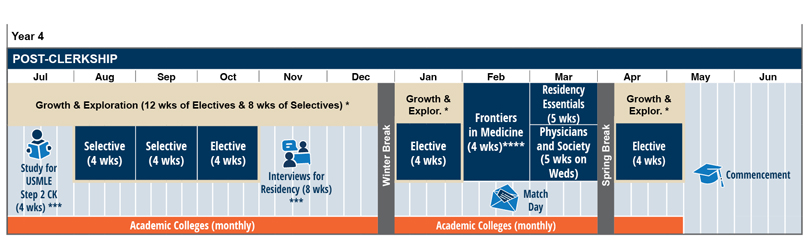
Key elements of the post-clerkship period, which takes place during the final year of medical school, include:
- Growth and Exploration
This component of the curriculum involves clinical rotations beyond the required 48-week core clerkships and includes:
- Selectives: Students complete subinternships, critical care, and emergency medicine rotations (eight weeks required).
- Electives: Students complete 18 weeks of electives (six in the clerkship phase and 12 in the post-clerkship phase). There are a variety of two- and four-week electives across all medical disciplines. For-credit electives offer students the opportunity to build strengths in a chosen field.
- Interview time: Students have up to eight weeks to interview for residency positions.
- Frontiers in Medicine
This course brings together the vast expanse of UT Southwestern faculty members who share their expertise with medical students to enhance clinical and scientific training. Returning to the classroom after clinical rotations offers students a valuable opportunity to reinforce and apply their knowledge.
First, students are presented with advanced topics that leverage both their basic science and clinical experiences. This course also offers flexibility for students to align their learning with specific interests and career goals. Basic science knowledge related to the causation of disease symptoms can improve diagnostic accuracy.
Seven different four-week Frontiers in Medicine courses are presented during the final year of medical school. All students are required to choose one of these four-week courses and may make their selection based on their interests. A portion of each four-week course will cover advanced evidence-based medicine and biostatistics.
The remaining portion of the four weeks will be dedicated to topic-specific content such as genomics, precision medicine, population medicine, biomedical informatics, quality improvement, cutting-edge therapeutics, and clinical trials.
Frontiers in Medicine courses include:
- Healthy Aging
- Neoplasia and Neoplastic Disease
- Emerging Infectious Diseases and the Microbiome in the 21st Century
- Behavioral Health and Neuromedicine
- Conception, Obstetrics, and Child Health
- Resuscitation Medicine
- Autoimmunity
- Hematology
- Physicians and Society
This course is scheduled concurrently with the Transitions in Clinical Training five-week course to cover selected topics for all future physicians, regardless of residency or career path. The course weaves together a variety of subjects, including:
- Multiculturalism
- Health economics and systems
- Medicine and the law, ethics
- Therapeutic conversations
- Behavioral and social determinants of health
Many of these topics will gain relevance after the students have completed clinical rotations.
- Residency Essentials
This final course recognizes that transitions in training for future physicians are taking on greater importance, including the transition from student to resident, resident to fellow, and fellow to practicing physician. Each passage has its own pitfalls and learning experiences.
The transition from medical student to intern is typically a period of high stress in which new interns assume greater workloads and responsibilities while facing difficult clinical and social challenges that may affect the quality of care that patients receive. The weeks between Match Day and graduation offer an ideal window for transitional clinical training.